Tightening
Sequences
The Appropriate Sequence to Tighten Bolts in a Joint
Most joints consist of several bolts and since the vast majority of bolts are not tightened simultaneously, the effect of tightening one bolt in the group has an effect on the preload in other previously tightened bolts in the group. Such an effect is called elastic interaction, or alternatively, bolt crosstalk. Ensuring that the bolt loading is even is often critical in gasketed joints to minimise possible leakages. Obtaining an even bolt load distribution is not clear-cut since the final bolt load usually differs from the initial bolt load. The mechanism that causes this is illustrated in the diagram below.

The outer two bolts have been tightened compressing the joint under the bolts. The middle bolt is subsequently tightened compressing the joint directly under the bolt but also compressing the joint slightly under the two other bolts leading to a loss of preload in these bolts. (There is an obvious exaggeration in the joint deflection in the image.) Two classical examples of tightening sequences are shown below, one for a rectangular array of bolts and the other, a circular array. Such sequences have been shown to result in providing a reasonably uniform bolt load. As such, they will minimise the preload scatter within a joint. On many gasketed joints and on solid, non-gasketed joints that are critical, a multiple pass tightening sequence is often used. With such a sequence, each bolt is tightened more than once so as to reduce the preload reduction caused by the tightening of the other bolts in the joint.
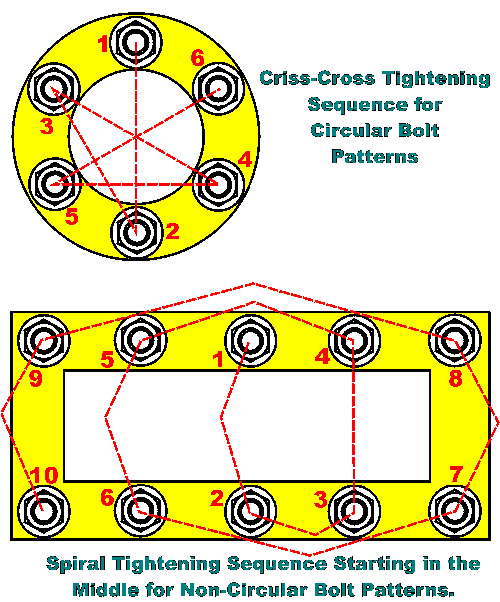
There are other tightening sequences that have been shown to produce a reasonable uniform bolt loading. For example, after ensuring that the joint surfaces are parallel to each other, going around the bolts in the joint and tightening them several times until no further rotation occurs was shown, from work completed in Japan, to provide acceptable results.
Tests have shown that the elastic interaction between bolts in a joint can have a significant effect on the preload (a reduction of 35%). The 'softer' the joint, that is, a joint with low stiffness, the larger the elastic interaction effect. A gasket typically results in a low stiffness joint and tightening the bolts incrementally, multiple times, is often needed to achieve an even loading. A multi-pass tightening sequence is one in which each bolt is tightened more than once.
Fuji manufactures a film product that will allow the pressure distribution within a bolted joint to be determined. This can be useful in checking and optimising a tightening sequence. The film is inserted between the plates of the joint and then the joint tightened. The subsequent colour change in the film determines the localised pressure. When pressure is applied, the microcapsules are broken and the colour-forming material that is released reacts with the colour-developing material to generate colour. The microcapsules are designed to react to various degrees of pressure, releasing their colour-forming material at a density that corresponds to the pressure.
If more information is needed on tightening sequences, the publication ASME PCC-1-2022 is a good source. This is a standard that provides guidelines for pressure-boundary bolted flange joint assembly.
|
